
- July 25, 2026
- 4:36 pm
As the clinical research industry continues to face budget pressures, many organizations are being asked to do more with less. Hiring freezes, downsizing, and increased reliance on offshore resources have become common strategies for controlling costs.
While these approaches may reduce short term expenses, they also introduce a less visible risk: the loss of specialized laboratory expertise.
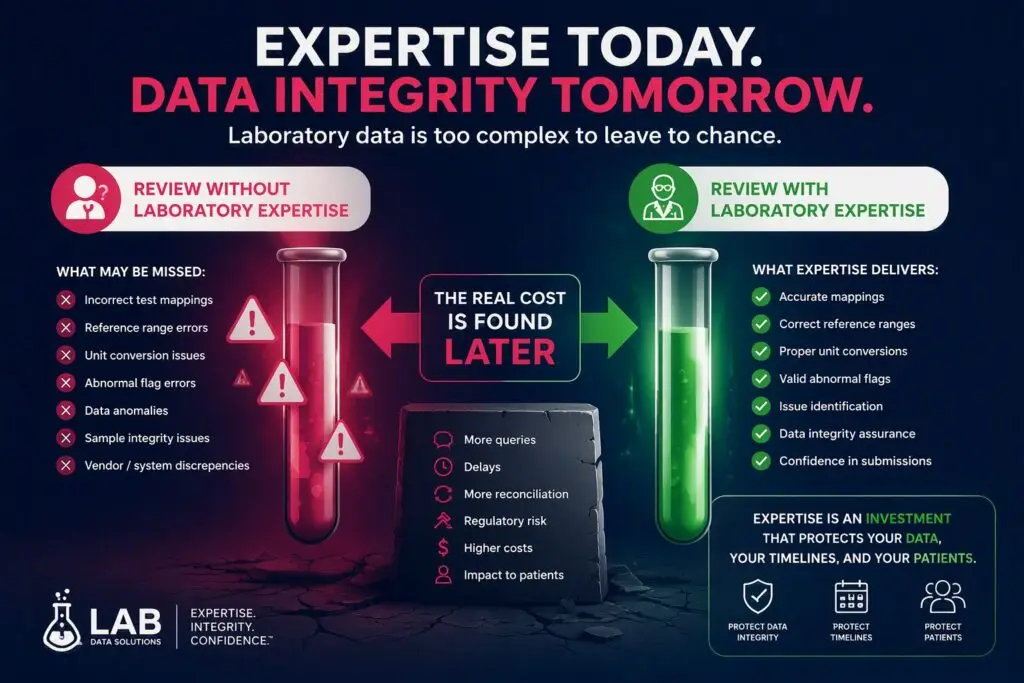
Laboratory data is one of the largest and most complex data streams within a clinical trial. Despite this, sponsors frequently underestimate the technical knowledge required to review, reconcile, and interpret laboratory data throughout a study. When laboratory review responsibilities are shifted to individuals without deep laboratory experience, the likelihood of errors increases significantly.
Laboratory Data Is Not Just Another Dataset
Unlike many clinical datasets, laboratory data contains unique complexities:
- Multiple vendors and laboratories
- Changing reference ranges
- Unit conversions
- Test code mappings
- Abnormal value interpretation
- Sample collection and processing issues
- Data transfer specifications
- Regulatory submission requirements
For experienced laboratory professionals, identifying inconsistencies and potential issues is second nature. They understand how laboratory systems operate, recognize common data anomalies, and know where hidden problems typically occur.
For individuals without laboratory experience, many of these issues may appear to be routine data discrepancies or may go unnoticed entirely.
The Cost of Missing Laboratory Errors
Sponsors often focus on the direct cost of data review activities. However, the real expense comes from errors discovered late in the study lifecycle.
A missed laboratory issue can lead to:
- Increased data queries
- Delayed database lock
- Additional reconciliation cycles
- Protocol deviation investigations
- Regulatory questions during submission
- Increased project management effort
- Delayed study timelines
When these issues are identified shortly before database lock or submission, corrective actions become more expensive and more disruptive.
The cost of remediation often far exceeds the cost of having qualified laboratory experts involved from the beginning.
Data Integrity Depends on Expertise
Data integrity is not simply a technology problem.
Organizations invest heavily in electronic systems, automated transfers, and sophisticated data platforms. However, technology can only identify what it has been programmed to identify.
Experienced laboratory reviewers bring contextual knowledge that systems alone cannot provide.
They understand:
- How laboratory results should behave over time
- Common vendor-specific issues
- Unexpected trends that warrant investigation
- Potential discrepancies between central and local laboratory data
- Risks associated with specimen handling and processing
Without this expertise, organizations may unknowingly accept inaccurate or incomplete data into their clinical databases.
Regulatory Expectations Continue to Rise
Regulators increasingly expect sponsors to demonstrate strong oversight of their clinical trial data.
Laboratory data often supports critical safety and efficacy endpoints. Errors within these datasets can have significant downstream consequences.
Sponsors are ultimately responsible for the quality, completeness, and accuracy of submitted data regardless of who performs the review activities.
Reducing expertise may lower costs on paper, but it does not reduce regulatory accountability.
Expertise Is an Investment, Not an Expense
The most successful clinical trials balance efficiency with quality.
This does not mean organizations must avoid global teams or cost-saving initiatives. It means they must ensure that laboratory data review remains under the guidance of professionals who understand the science, processes, and risks associated with laboratory data management.
Laboratory expertise helps organizations:
- Identify issues earlier
- Reduce reconciliation effort
- Improve data quality
- Protect submission timelines
- Strengthen regulatory confidence
- Lower overall study costs
In today’s environment, expertise is often viewed as an expense to minimize.
In reality, it is one of the most effective investments sponsors can make to protect both their clinical data and their development programs.
Contact Us if you would like to learn more about our Local Laboratory Expertise!